 how-to
How to Write a Small Business Supplement HACCP Plan
Last Updated: October 28, 2026
Quick Summary
A supplement HACCP plan is a written, working document showing how your company identifies food safety hazards, controls them, and proves those controls work. It covers hazards tied to your products from raw ingredient receipt through shipment, and small businesses can build one without a large quality department.
- Assemble a small team covering quality, production, purchasing or receiving, and sanitation, with one clear plan owner.
- Analyze hazards step by step, recording likelihood, severity, and a one-sentence rationale for each.
- Screen supplement-specific hazards including adulteration, undeclared allergens, potency, and pathogens in raw botanicals.
- Set measurable critical limits, monitoring methods, and corrective actions for each critical control point.
- Schedule verification reviews within the first few months and update the plan whenever suppliers, products, or equipment change.
Table of Contents
- What a Supplement HACCP Plan Covers and Who Needs One
- Assembling a HACCP Team for a Small Business
- Conducting a Dietary Supplement Hazard Analysis
- Tying Supplement GMPs to Preventive Controls
- Building a HACCP Plan Template Step by Step
- Setting Monitoring, Corrective Actions, and Records
- Scheduling Your First Verification Review and Plan Updates
- Frequently Asked Questions
Small supplement companies often assume a HACCP plan is a job for a large manufacturer with a full quality department. It is not. A small business supplement HACCP plan is a written, working document that shows how your company finds food safety hazards, controls them, and proves it.
HACCP stands for Hazard Analysis and Critical Control Points. It is a system for identifying what could make a product unsafe and deciding where to stop that from happening.
The work can feel heavy at first. Still, you do not need to solve everything on day one. Break it into clear parts: decide who builds the plan, list your hazards, set your controls, and decide how you will watch them. Each section below covers one of those parts.
What a Supplement HACCP Plan Covers and Who Needs One
A supplement HACCP plan covers the hazards tied to your specific products, from raw ingredient receipt to finished goods shipment. It names each hazard, the control that manages it, and the records that prove the control works.
Most supplement facilities that are subject to FSMA's current Good Manufacturing Practice and preventive controls rule need a written food safety plan. Confirm your status against the FDA's rules, since exemptions and qualified-facility rules can apply to smaller operations.
Common hazards in supplements include:
- Biological: pathogens such as Salmonella in botanical or powder ingredients
- Chemical: heavy metals, pesticide residues, and undeclared allergens
- Physical: metal fragments, glass, and foreign material from equipment
A good plan starts with a clear product description and process flow. For a broader walkthrough from start to finish, see step-by-step HACCP implementation guide. If you cannot draw each step from receiving to shipping, you are not ready to judge the hazards.
Assembling a HACCP Team for a Small Business
Your HACCP team does not need to be large. A small supplement company might have three or four people covering production, quality, purchasing, and sanitation. What matters is that each person knows the process well enough to spot problems.
Look for these roles on your team:
- Quality lead: owns the plan and keeps the records organized
- Production supervisor: knows the equipment and line steps
- Purchasing or receiving staff: tracks ingredient specs and supplier certificates
- Sanitation lead: manages cleaning and environmental controls
When in-house expertise is thin, many small businesses bring in a contract food safety consultant for the first plan. You can review contract food safety consultant roles and engagement options to see how that support is structured. Our guide to hiring food safety regulatory consultants explains how to decide whether outside help makes sense for your team. The consultant builds the initial framework, and your staff keeps it running.
Write down who is responsible for what. A plan that nobody owns will fall apart after the first audit.
Conducting a Dietary Supplement Hazard Analysis
A hazard analysis asks one question for each process step: what could go wrong here, how likely is it, and how serious would the outcome be? For supplements, the answer must go beyond generic food hazards. Ingredient identity, adulteration, allergens, potency, and supplier risk are the hazards that most often drive a small supplement plan.
Work through your process step by step and record the reasoning, not just the conclusion:
- Write the step (for example, "receive botanical powder").
- List every biological, chemical, and physical hazard that could enter or survive at that step.
- Rate likelihood and severity using a simple scale (for example, low, medium, high) and write one sentence of rationale.
- Note the control already in place, such as a supplier certificate of analysis, a receiving test, or a metal detector.
- Decide whether the step is a critical control point (CCP), a preventive control, or covered by a prerequisite program such as sanitation or supplier approval.
Supplement-specific hazard categories to screen at every step
- Ingredient identity and adulteration: an herb or botanical that is substituted, diluted, or spiked with an undeclared substance. Control through supplier qualification, identity testing, and certificates of analysis.
- Allergens: undeclared allergens from shared equipment, carriers, or excipients. Control through allergen mapping, dedicated lines or validated cleaning, and label review.
- Potency and composition: a finished product that does not match its label. Control through blending verification, assay testing, and batch records.
- Microbiological contamination: Salmonella and other pathogens in raw botanicals or powders. Control through supplier kill-step validation and receiving tests.
- Chemical contamination: heavy metals, pesticide residues, and residual solvents. Control through supplier specifications and periodic testing.
- Physical hazards: metal, glass, and foreign material from equipment. Control through metal detection, sieving, and equipment inspection.
Worked example: botanical capsule blend
Consider a small company that blends a dried herb into a capsule product. A simplified process flow is:
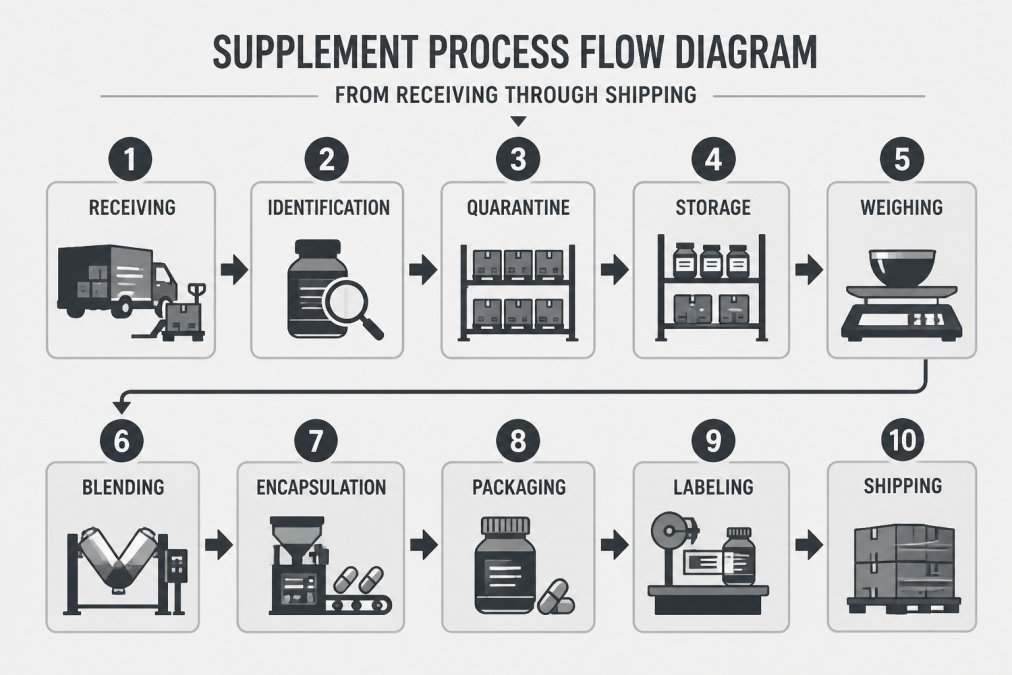
- Receive raw botanical powder
- Store in controlled warehouse
- Weigh and dispense
- Blend with excipients
- Encapsulate
- Metal detect
- Package and label
- Ship
A hazard assessment for this flow might look like this:
| Step | Hazard | Likelihood | Severity | Rationale | Control | CCP? |
|---|---|---|---|---|---|---|
| Receive botanical powder | Salmonella | Medium | High | Raw botanicals are a known carrier; supplier kill step may vary | Supplier verification plus lot receiving test | Yes |
| Receive botanical powder | Adulteration or identity | Medium | High | Economically motivated substitution is common in botanicals | Supplier qualification, certificate of analysis, identity test | No (preventive control) |
| Blend | Undeclared allergen carryover | Low | High | Shared equipment and excipients can carry allergens | Allergen mapping and validated cleaning | No (prerequisite program) |
| Encapsulate | Metal fragments | Low | High | Equipment wear can shed metal | Metal detection after encapsulation | Yes |
| Package and label | Mislabeling (allergen, potency) | Medium | High | Label errors are a leading recall cause | Label review and verification | No (preventive control) |
For the receiving step, the rationale matters as much as the rating. The supplier provides a certificate showing a kill step, but the company also runs a receiving test for each lot. Because the hazard is severe and supplier controls can drift, the receiving test is treated as a CCP with a critical limit of a negative result before release.
Good hazard analysis is honest and specific. Many small teams underrate hazards because they have never had a problem. Check supplier data and recall reports before you decide a hazard is unlikely, and write down why each control was chosen. That written rationale is what auditors and inspectors actually review.
Tying Supplement GMPs to Preventive Controls
CGMPs and preventive controls work together. CGMPs set the baseline for clean facilities, trained staff, and sound equipment. Preventive controls focus on the specific hazards that your analysis found.
Think of CGMPs as the floor and preventive controls as the walls built on top of it. If your facility is dirty or your equipment is poorly maintained, no HACCP plan will hold up. Fix the basics first, then add targeted controls for the hazards that remain.
Many small businesses find it helpful to map each preventive control back to a CGMP requirement. That map shows auditors that the plan is grounded in the rules, not invented on the fly.
Building a HACCP Plan Template Step by Step
A practical plan template keeps the required parts in one place and gives staff a form they can actually use on the floor. The outline below is an editable starting point for a small supplement operation. Replace the example entries with your own product and process details.
Section 1: Product description
| Field | Example entry |
|---|---|
| Product name | Botanical capsule blend |
| Ingredients | Dried herb, cellulose capsule, magnesium stearate |
| Form | Capsule |
| Packaging | 60-count HDPE bottle |
| Intended use | Adult dietary supplement |
| Shelf life | 24 months |
| Label claims | Structure/function claims only |
Section 2: Process flow
List each step from receiving to shipping and attach a simple diagram. Example steps: receive raw materials, store, weigh and dispense, blend, encapsulate, metal detect, package, label, ship.
Section 3: Hazard analysis
Use a table with these columns: step, hazard, likelihood, severity, rationale, existing control, and control type (CCP, preventive control, or prerequisite program). See the worked example in the hazard analysis section for sample entries.
Section 4: Preventive controls and CCPs
| Control point | Hazard controlled | Control measure | Critical limit | Monitoring method | Frequency | Responsible person |
|---|---|---|---|---|---|---|
| Receiving test | Salmonella | Lot testing before release | Negative result | Lab test | Each lot | Quality lead |
| Metal detection | Metal fragments | In-line detector | No detection at set sensitivity | Detector check | Each batch | Production supervisor |
Section 5: Corrective actions
For each control, write what staff should do if a limit is missed. Example: hold the lot, notify the quality lead, retest or reject, document the cause, and record the disposition.
Section 6: Verification and validation
Record how you will confirm the plan works: monitoring record review, calibration checks, internal audits, and product testing. Note who reviews and how often.
Section 7: Records and retention
List every log, certificate, and test result the plan relies on. Use one system, whether paper or digital, and store records long enough to meet FDA requirements.
Small-business implementation notes
- Assign one owner for the plan and one backup so records do not stall during vacation or turnover.
- Start with the highest-risk steps (receiving and any kill step) and expand the template as you add products.
- If in-house expertise is thin, a contract food safety consultant can build the initial framework, but your staff must run the monitoring and records.
- Review the template whenever you change a supplier, add a product, or modify equipment.
Setting Monitoring, Corrective Actions, and Records
Monitoring tells you whether a control is working. Each control needs a measurable critical limit, a method for checking it, and a schedule.
Corrective actions tell staff what to do when a limit is missed. Write them in plain language. Common actions include holding product, retesting, notifying the quality lead, and documenting the cause.
Records are where many small plans fail. Keep logs for monitoring, corrective actions, and supplier documents. Use one system, whether paper or digital, and store records long enough to meet FDA requirements.
Watch out: Do not rely on memory or verbal reports. If a deviation is not written down, auditors will treat it as if it never got handled.
Scheduling Your First Verification Review and Plan Updates
Verification proves that the plan works in practice. Schedule a review within the first few months after launch. Check whether monitoring is happening, whether corrective actions were followed, and whether any new hazards showed up.
Update the plan whenever you change a supplier, add a product, or modify equipment. Review it at least once a year even if nothing changed.
Many small businesses also run an internal audit before any outside inspection. If you want help conducting or supporting these reviews, see the full range of consulting services available. That practice catches gaps early.
Your supplement HACCP plan is only as good as the habits behind it. Start with a clear team, an honest hazard analysis, and simple records.
Frequently Asked Questions
Do dietary supplement businesses need a HACCP plan?
Whether a specific facility needs a HACCP plan depends on its activities and applicable requirements. Confirm the requirements for your operation with an appropriate professional and consult current FDA guidance.
How often should a HACCP plan be reviewed?
Review a HACCP plan when changes could affect hazards or controls. Consider documenting the review and any changes made.
Can a small supplement business use a template HACCP plan?
A template can give a small business a useful starting structure, including the product description, process flow diagram, hazard table, and monitoring logs. It cannot replace the hazard analysis itself, because hazards depend on your specific ingredients, equipment, suppliers, and facility. Adapt every template section to your operation, and make sure the team that signs off on the plan understands each control it lists.
What records should a supplement HACCP plan include?
A plan may include records relevant to its hazard analysis, controls, monitoring, corrective actions, and verification. Consult current official guidance to determine which records apply to your operation.